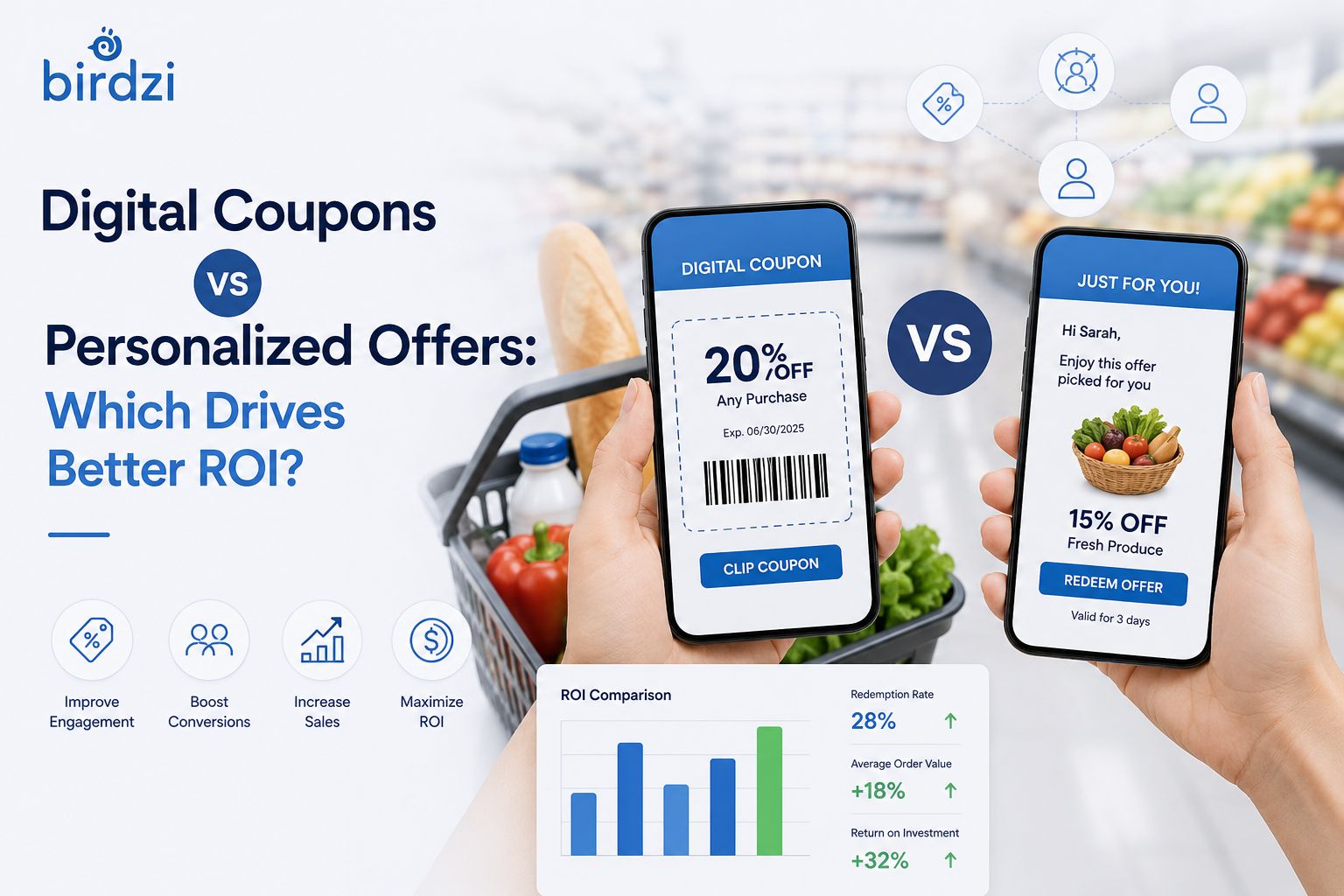
Which approach drives better grocery ROI?
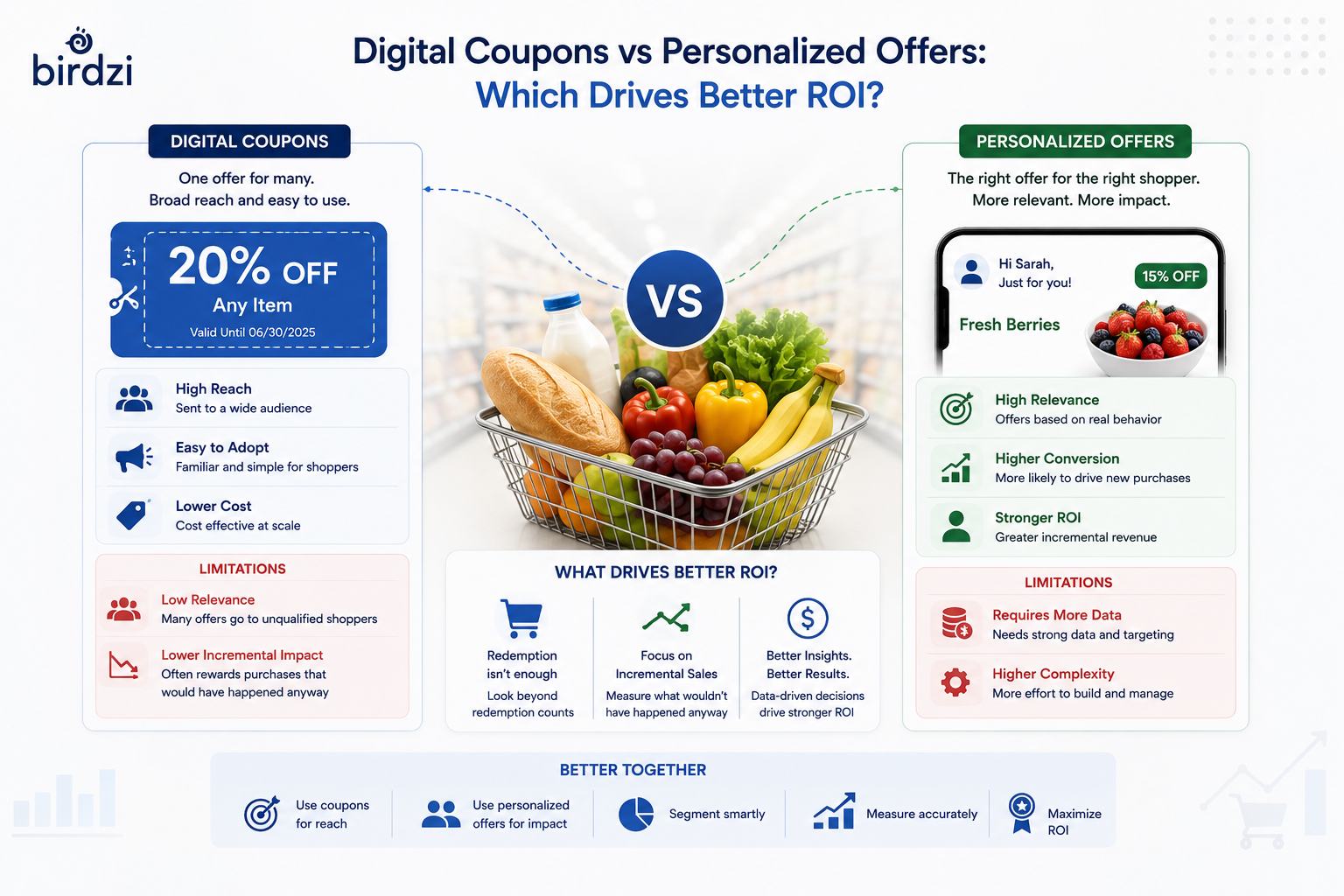
Grocery retailers do not need to choose between digital coupons and personalization. Digital coupons are a delivery format; personalization determines who receives an offer, what the offer contains, and when it arrives. The more useful comparison is between mass digital coupons sent broadly and personalized digital offers informed by shopper behavior.
Both approaches can support sales, trial, loyalty, and merchandising goals. But they do not create value in the same way, and redemption alone cannot tell retailers which approach produced the stronger business result. The right decision begins with knowing the shopper, continues with relevant engagement, and ends with measurement that connects activity to revenue.
What Mass Digital Coupons Do Well
Mass digital coupons are the modern version of a familiar promotional tool. Shoppers load an offer through a retailer’s app or website and receive the discount when they identify their loyalty account at checkout.
Their primary advantage is reach. A retailer can distribute a single offer across a large audience quickly, making mass coupons useful for broad awareness, new-product trial, seasonal events, or inventory objectives. The format is also familiar to shoppers, which can reduce friction.
The limitation is not that these coupons are digital. It is that the same offer is delivered to many shoppers regardless of their needs or likely behavior. Some recipients may have little interest in the product, while others may already intend to buy it. In the second case, the promotion may generate a redemption without changing the purchase decision, reducing margin on a sale that could have occurred anyway.
How Personalized Offers Work
Personalized offers use shopper intelligence to select a more relevant product, incentive, or message for each shopper or audience. Purchase history can contribute to that decision, but effective personalization goes further. It can incorporate category affinity, purchase frequency and recency, engagement patterns, lifecycle behavior, price sensitivity, and the retailer’s campaign objective.
A relevant offer does not always have to discount an item the shopper already buys. It might introduce a complementary product, encourage a return to a lapsed category, increase basket size, or give an at-risk shopper a reason to reengage. The goal is not simply to predict what someone will purchase. It is to determine where an offer can create meaningful action without giving away unnecessary margin.
Personalization once demanded significant analytical and operational effort. Modern retail intelligence platforms can reduce that complexity by helping teams build audiences, curate individualized savings, automate engagement as behavior changes, and activate offers across connected channels.
This is where Birdzi’s Shopper Personalization Platform becomes valuable, helping retailers manage that complexity without losing relevance. When done properly, the relevance of each offer tends to be far higher, which typically shows up in stronger conversion rates.
Where the ROI Difference Actually Comes From
The ROI difference is not simply the cost of distributing one campaign versus another. It comes from how effectively promotional investment changes shopper behavior while protecting margin.
A mass coupon may produce more total redemptions because it reaches more people. A personalized offer may reach a narrower audience while generating a higher response rate, greater incremental sales, or a better margin outcome. Neither result should be assumed in advance. Performance depends on the audience, product, incentive, timing, and campaign objective.
That is why redemption rate is only one part of the measurement framework. Retailers should also consider incremental sales or units, basket impact, margin, cost per incremental conversion, repeat purchasing, and lift against an appropriate control or comparison group. Connected shopper and transaction data provide the foundation; disciplined test design helps distinguish behavior influenced by the offer from purchases likely to have happened anyway. This becomes clearer with Birdzi’s Shopper Engagement Tools tracking how each offer actually performs.
A Better Way to Compare the Two Approaches
Rather than relying on a hypothetical success story, retailers can run a structured test. For example, a grocer planning a holiday snack promotion could identify comparable shopper groups and expose them to different treatments: a mass category coupon, personalized product-level offers, and a control group receiving no promotional treatment.
After the campaign, the retailer could evaluate more than redemption. Did either treatment increase category spend or units relative to the control? Did shoppers add more items to their baskets? How much margin did the discount consume? Did the behavior continue after the promotion ended?
The answer may vary by audience. A broad offer could perform well with shoppers who are new to the category, while personalized incentives could produce stronger results among established customers with identifiable affinities. The purpose of the test is not to declare one tactic the universal winner. It is to learn where each tactic creates the greatest value.
How Birdzi Connects Shopper Insight to Revenue
Birdzi’s Adaptive Retail Intelligence helps grocers move from data to action across three connected priorities.
| Priority | How it supports promotion performance |
| Know Your Shopper | Understand value, frequency, loyalty, migration, purchasing patterns, and business performance. DataScope, Pulse, and AskKea help teams explore performance, receive key insights, and ask questions of grocery data. |
| Engage and Grow | Turn intelligence into personalized savings, AI-curated one-to-one discounts, automated retailer journeys, targeted audiences, email engagement, connected activation, and digitally delivered offers. |
| Unlock CPG Investment | Use shopper intelligence to support brand-funded journeys and apply closed-loop measurement that ties CPG-funded activity to shopper and sales outcomes. |
This connected approach allows retailers to run mass, segmented, and individualized promotions from a common foundation. Teams can better understand which shoppers respond to each strategy, activate offers through the appropriate channels, and measure outcomes beyond surface-level engagement.
The same intelligence can also strengthen retailer and CPG collaboration. When brand-funded activity is triggered by shopper behavior and measured against sales outcomes, retailers can demonstrate value more clearly and build more accountable investment opportunities.
Choosing the Right Promotional Strategy
Mass digital coupons remain useful when the business goal depends on broad exposure. Personalized offers are often better suited to goals that require relevance, such as increasing basket size, reengaging lapsing shoppers, expanding category participation, or reducing unnecessary discounting.
The strongest strategy may use both. A retailer could begin with a broad offer to introduce a product, then use shopper response and purchase behavior to shape more relevant follow-up engagement. It could reserve deeper incentives for shoppers whose behavior suggests that a promotion may change the outcome, while avoiding discounts for customers already likely to purchase.
- The decision should be guided by four questions:
- What shopper or business behavior should the campaign influence?
- Which audience is most relevant to that objective?
- What offer or message is likely to motivate incremental action?
- How will the retailer measure lift, margin, and longer-term impact?
Conclusion
Mass digital coupons and personalized offers are not competing technologies. They are different promotional approaches that can serve distinct purposes within the same strategy.
The opportunity for grocers is to move beyond one-size-fits-all discounting and choose the level of relevance that fits each objective. With Birdzi’s Adaptive Retail Intelligence, retailers can know their shoppers, engage them with greater relevance, measure the business impact, and use those insights to support both retail growth and CPG investment.
Frequently Asked Questions
Q1. Are digital coupons still effective for grocery retailers?
A: Yes. Digital coupons can support broad awareness, product trial, seasonal promotions, and inventory goals. Their effectiveness depends on the audience, offer economics, business objective, and measurement approach.
Q2. What is the difference between a digital coupon and a personalized offer?
A: A digital coupon describes how an offer is delivered and redeemed. Personalization describes how the retailer determines who receives the offer and what content, product, or incentive is most relevant. A digital coupon can be personalized.
Q3. Why can personalized offers produce stronger ROI?
A: Personalized offers can focus promotional spend on shoppers and situations where an incentive is more likely to change behavior. This can reduce irrelevant discounting, but performance should be validated through testing rather than assumed.
Q4. How should grocers measure promotional performance?
A: Retailers should look beyond redemption and consider incremental sales or units, margin, basket impact, cost per incremental conversion, repeat behavior, and lift against an appropriate control or comparison group.
Q5. Does a retailer need to choose one approach?
A: No. Many retailers use mass offers for reach and personalized offers for relevance. The right mix depends on the campaign objective, audience, economics, and available shopper intelligence.
Q6. How does Birdzi support promotion ROI?
A: Birdzi connects shopper understanding, personalized engagement, activation, and closed-loop measurement. This helps grocers determine which approaches work for which shoppers and connect promotional activity to sales outcomes.
Sign up for Updates
Stay current on the latest happenings at Birdzi!
"*" indicates required fields
Related Posts
 " alt="How Grocers Can Deliver More Relevant Product Suggestions" />
 " alt="Using Shopping Frequency to Understand Customer Value" />
 " alt="How Retailers Can Create More Meaningful Shopper Touchpoints" />
Request a 1-on-1 Demo
There’s no substitute for seeing Birdzi’s capabilities first-hand with a seasoned expert to answer all your questions.
"*" indicates required fields