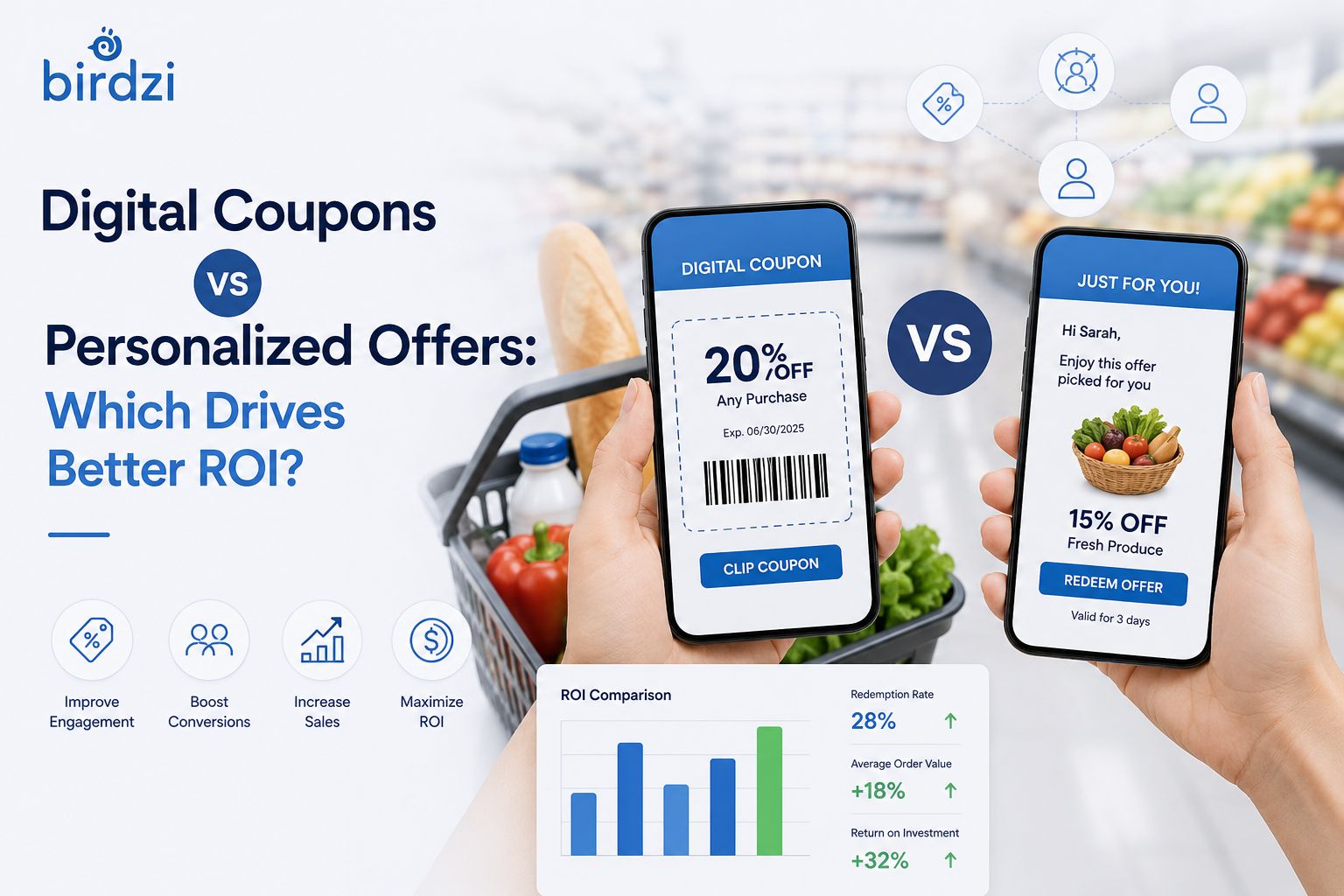
A grocery marketing budget rarely goes to just one tactic. Most retailers are running digital coupons and some form of personalized offer at the same time, often without a clear answer to which one is actually paying off. Both tactics aim to increase purchases, but they work in very different ways, and that difference shows up directly in return on investment.
This comparison carries more weight today than it once did. Marketing budgets face tighter scrutiny, and grocery margins leave little room for spend that fails to convert. Knowing where each approach delivers value, and where it comes up short, helps retailers direct their dollars toward the strategy that actually drives results.
Digital Coupons in Grocery Retail
Digital coupons are the modern version of a familiar tool. Instead of clipping a paper coupon, shoppers load a discount onto their loyalty account through an app or website, then redeem it automatically at checkout.
Their strength is reach. A single digital coupon campaign can go out to an entire customer base at once, and because the format is simple, adoption tends to be high. Shoppers already understand how a coupon works, so there is little friction in getting them to use one.
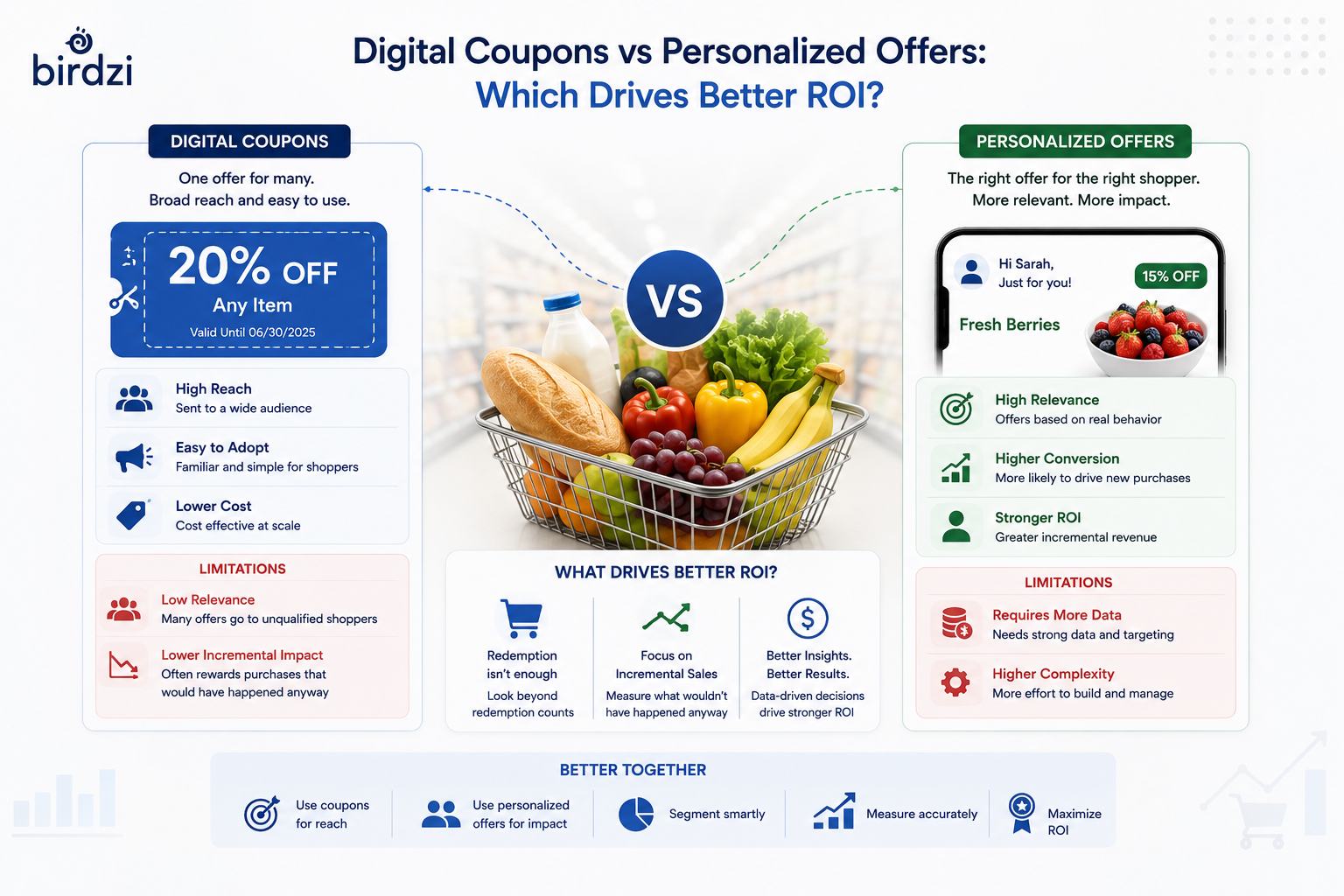
Their weakness is relevance. A coupon for laundry detergent sent to a customer who has never purchased laundry detergent is unlikely to convert, no matter how large the discount. Broad reach without targeting often means a large share of redemptions go to customers who were already planning to buy the product anyway, which limits the actual incremental revenue the coupon generates.
Personalized Offers in Grocery Retail
Personalized offers take a narrower, more targeted approach. Rather than sending the same discount to everyone, retailers use shopper data to identify which products a specific customer is likely to want, then deliver an offer built around that individual’s purchase history.
This is where customer segmentation analytics becomes central. Instead of treating the customer base as one group, segmentation divides shoppers into meaningful categories based on behavior, such as frequent produce buyers, occasional bulk shoppers, or households with young children. Offers are then matched to the segment, or in more advanced cases, to the individual.
The tradeoff is scale. Personalized offers require more data and more sophisticated targeting to execute well, and they are harder to run at the same broad volume as a blanket coupon campaign. This is where Birdzi’s Shopper Personalization Platform becomes valuable, helping retailers manage that complexity without losing relevance. When done properly, the relevance of each offer tends to be far higher, which typically shows up in stronger conversion rates.
Where the ROI Difference Actually Comes From
The ROI gap between these two tactics rarely comes down to which one is cheaper to send. Digital coupons are usually less expensive to distribute at scale, while personalized offers cost more to build and manage. The real difference comes from conversion quality.
A coupon sent to a broad audience often converts customers who would have purchased the product regardless, meaning the retailer discounts a sale that was already going to happen. A personalized offer, built around a specific shopper’s actual habits, is more likely to influence a purchase that would not have occurred otherwise, which is the kind of incremental revenue that justifies marketing spend in the first place.
Measuring this accurately requires retail coupon performance analytics that go beyond redemption counts. Redemption rate alone does not reveal whether an offer created a new sale or simply subsidized an existing one, and that distinction is where the true ROI comparison lives, one that becomes clearer with Birdzi’s Shopper Engagement Tools tracking how each offer actually performs.
Putting Both Tactics to the Test
A mid sized grocery chain wanted to boost sales in its snack category ahead of a holiday weekend. Rather than choosing one tactic, the retailer tested both at once. One half of its customer base was sent a standard digital coupon for the category. The other half received a personalized offer built around each shopper’s own snack purchase history, so someone who regularly bought pretzels saw a pretzel offer, while someone who bought chips saw a chip offer.
Two weeks later, the results told two very different stories depending on how they were read. Total redemptions were higher on the coupon side, simply because it reached more people with less friction to redeem. But when the retailer looked at incremental revenue, meaning purchases that would not have happened without the offer, the personalized group came out ahead. Those shoppers were not just redeeming a discount they already intended to use. They were buying a product they had not planned to buy that trip.
The coupon did its job of driving volume. The personalized offer did its job of creating new demand. Judged only on redemption counts, the coupon appears to win. Judged on actual incremental sales, the personalized offer delivers the stronger return.
Why Birdzi Helps Retailers Measure This Accurately
Comparing these two tactics fairly requires more than a spreadsheet of redemption numbers. It requires connected data that shows what a customer would likely have purchased anyway, versus what a specific offer actually influenced.
Birdzi brings shopper data together across loyalty, point of sale, and digital channels, giving retailers a foundation to build both broad coupon campaigns and targeted personalized offers from the same connected view. With Birdzi’s Shopper Analytics platform built into that foundation, retailers can identify which shopper groups respond better to broad discounts and which respond better to individualized offers, rather than applying one strategy across the entire customer base.
This connected approach also makes it possible to measure true ROI after the campaign runs, comparing incremental revenue and cost per converted customer rather than relying on redemption counts alone.
Choosing the Right Approach
In practice, most grocery retailers benefit from using both tactics, just not for the same purpose. Digital coupons remain useful for broad awareness, clearing excess inventory, or driving trial of a new product across a wide audience. Personalized offers work best when the goal is deepening loyalty with existing customers or increasing basket size among shoppers who are already engaged.
The mistake is treating both tactics as interchangeable and measuring them the same way. A coupon campaign judged only on reach will always look successful. A personalized offer judged only on redemption volume will often look weaker than it actually is, even when it delivers stronger financial results.
Conclusion
Digital coupons and personalized offers are not competing replacements for one another. They serve different purposes and succeed under different conditions. The retailers who benefit most are the ones who measure each tactic on the right terms, using retail coupon performance analytics to separate genuine incremental sales from redemptions that would have happened anyway.
With a connected platform like Birdzi, grocery retailers gain the visibility needed to run both strategies effectively, matching the right tactic to the right customer and measuring ROI based on real impact rather than surface level metrics.
Frequently Asked Questions
Q1. Are digital coupons still effective for grocery retailers?
A: Yes, digital coupons remain effective for broad awareness and driving trial, particularly when reach matters more than precise targeting.
Q2. Why do personalized offers often outperform coupons on ROI?
A: Personalized offers are built around individual purchase history, which increases the likelihood of influencing a purchase that would not have happened otherwise, rather than discounting a sale that was already planned.
Q3. How should grocery retailers measure coupon performance accurately?
A: Retailers should look beyond redemption counts and evaluate incremental revenue and cost per converted customer, since redemption alone does not show whether a coupon created a new sale.
Q4. Do grocery retailers need to choose between coupons and personalized offers?
A: Not necessarily. Many retailers use both, applying coupons for broad reach and personalized offers for deeper engagement with existing customers.
Q5. How does Birdzi support this kind of ROI comparison?
A: Birdzi connects loyalty, point of sale, and digital data into one platform, allowing retailers to build both coupon and personalized offer campaigns from the same shopper insights and measure true ROI afterward.
Sign up for Updates
Stay current on the latest happenings at Birdzi!
"*" indicates required fields
Related Posts
 " alt="Improving Grocery Shopper Engagement With Better Data" />
 " alt="Omnichannel Grocery Marketing: How to Create Consistent Shopper Experiences Across Every Touchpoint" />
 " alt="Advanced Shopper Analytics for Smarter Grocery Retail Decisions" />
Request a 1-on-1 Demo
There’s no substitute for seeing Birdzi’s capabilities first-hand with a seasoned expert to answer all your questions.
"*" indicates required fields