Building strong customer relationships has always been important for grocery retailers. Today, however, success depends on much more than keeping customer records or sending promotional emails. Shoppers expect personalized offers, relevant recommendations, seamless experiences across every channel, and loyalty programs that genuinely reward their buying habits.
To meet these expectations, retailers need technology that not only stores customer information but also helps them understand shopper behavior and turn those insights into action.
Many grocery retailers already use a Customer Relationship Management (CRM) system to organize customer information and manage communications. While a CRM remains a valuable business tool, it was never designed to solve many of the challenges modern grocery retailers face. That is why more retailers are investing in Customer Intelligence Platforms that combine data, analytics, and personalization to improve customer engagement and drive measurable business growth.
Understanding the difference between these two solutions can help you choose the right technology for your grocery business.
According to McKinsey & Company, retailers that successfully implement personalization can achieve 1 to 2 percent incremental sales growth in grocery while improving customer loyalty and marketing efficiency. These results come from using customer data to deliver relevant, personalized experiences rather than broad, one-size-fits-all campaigns.
What Is a Grocery CRM?
A Customer Relationship Management (CRM) system is designed to help businesses organize customer information and manage interactions.
For grocery retailers, a CRM typically stores information such as:
- Customer names and contact details
- Loyalty membership information
- Purchase history
- Customer service records
- Email marketing activity
- Sales and communication history
Having all this information in one place makes it easier for teams to manage customer relationships and maintain accurate records.
However, most CRM systems focus on managing customer information rather than understanding customer behavior. They tell you who your customers are and record past interactions, but they offer limited insight into why shoppers behave as they do or which actions will improve future engagement.
What Is a Customer Intelligence Platform?
A Customer Intelligence Platform goes beyond customer record management.
Instead of simply storing information, it continuously analyzes customer behavior across multiple systems to identify patterns, uncover opportunities, and help retailers make smarter business decisions.
A Customer Intelligence Platform connects data from:
- Point of Sale systems
- Loyalty programs
- E-commerce platforms
- Mobile applications
- Digital coupons
- Email campaigns
- Website interactions
- Retail media platforms
By bringing all these data sources together, retailers gain a complete view of every shopper instead of looking at disconnected pieces of information.
More importantly, the platform transforms raw data into actionable insights that marketing, merchandising, and loyalty teams can use to improve customer engagement and business performance.
Why Grocery Retail Needs More Than Customer Records
Grocery retail is one of the most data-rich industries.
Every transaction tells a story about customer preferences, shopping habits, price sensitivity, brand loyalty, and purchasing behavior.
Retailers need answers to questions such as:
- Which shoppers are becoming less engaged?
- Which customers are most likely to respond to a personalized offer?
- Which promotions increase basket size?
- Which households have the highest lifetime value?
- Which products are commonly purchased together?
- Which campaigns generate measurable revenue?
A traditional CRM can record customer activity, but it cannot automatically answer these business questions.
Retailers need technology that analyzes shopper behavior, identifies opportunities, and recommends actions that improve loyalty, retention, and revenue.
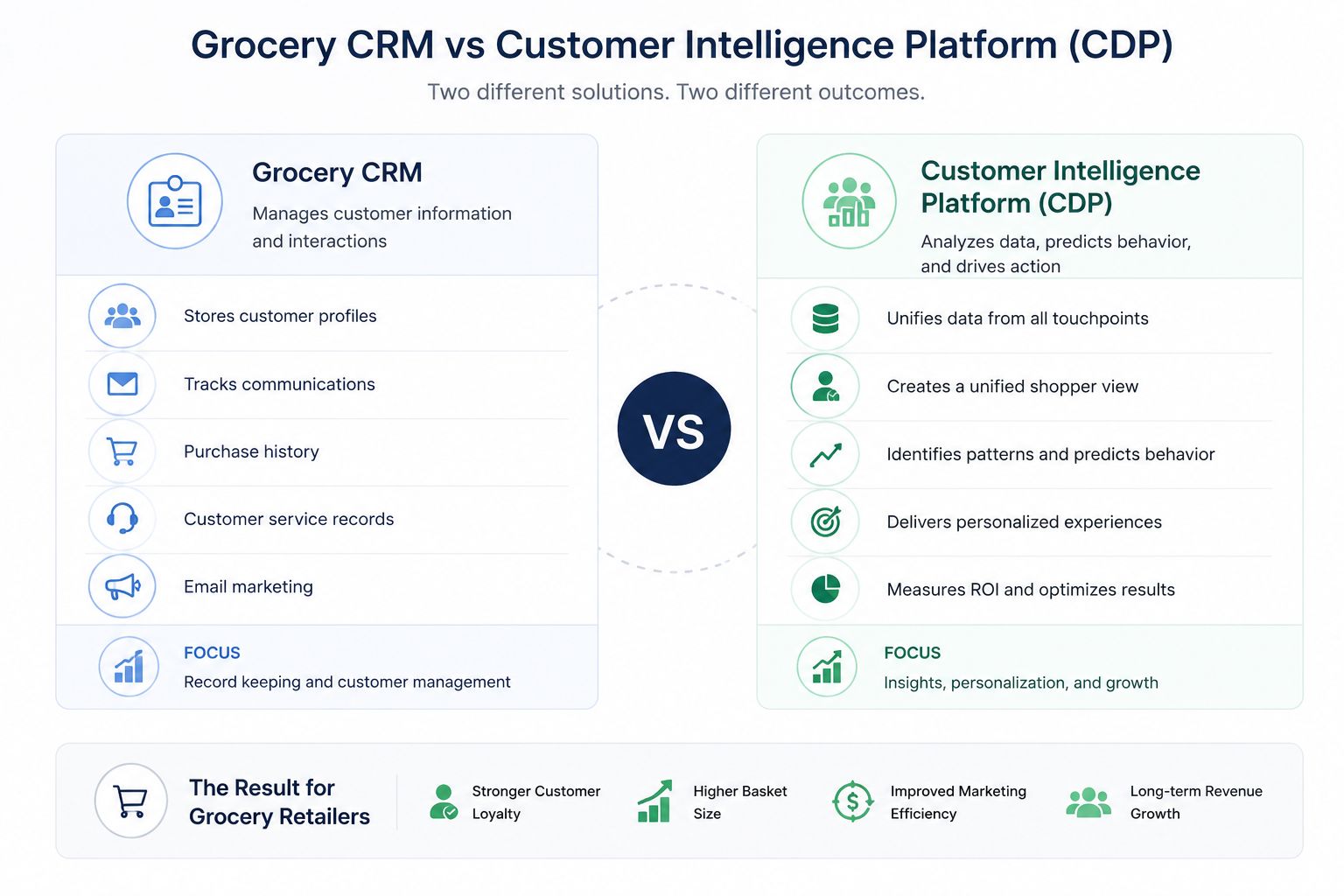
Grocery CRM vs Customer Intelligence Platform
Although both solutions work with customer data, they serve very different purposes.
| Feature | Grocery CRM | Customer Intelligence Platform |
| Stores customer profiles | ✅ | ✅ |
| Tracks customer communications | ✅ | ✅ |
| Combines Point of Sale, loyalty, ecommerce, and app data | Limited | ✅ |
| Creates a unified shopper view | Partial | ✅ |
| Identifies shopping patterns | ❌ | ✅ |
| Predicts customer behavior | ❌ | ✅ |
| Supports personalized offers | Limited | ✅ |
| Measures campaign ROI | Basic | Advanced |
| Supports merchandising decisions | ❌ | ✅ |
| Built specifically for grocery retail | Rarely | ✅ |
The biggest difference is straightforward.
A CRM helps retailers manage customer information.
A Customer Intelligence Platform helps retailers understand shopper behavior, uncover opportunities for growth, personalize customer experiences, and make data-driven decisions that improve business performance.
Why First Party Data Is the Foundation of Better Customer Experiences
As privacy regulations evolve and third-party cookies become less effective, first-party data has become one of the most valuable assets a grocery retailer owns.
Every loyalty transaction, point-of-sale purchase, online grocery order, mobile app interaction, and digital coupon redemption provides valuable information about customer preferences. The challenge is no longer collecting more data. The challenge is connecting that information and using it to improve every shopper interaction.
When first-party data is unified across all customer touchpoints, retailers can:
- Build a complete view of each shopper.
- Deliver more relevant promotions.
- Improve customer retention.
- Increase basket size.
- Make smarter merchandising decisions.
- Measure the true impact of marketing campaigns.
This is where Customer Intelligence Platforms deliver significantly more value than traditional CRM systems. However, turning customer insights into successful campaigns also requires a strong marketing strategy and effective execution. Working with experienced partners such as Innovar Marketing Agency can help businesses translate customer insights into targeted marketing initiatives that improve engagement and growth.
How Birdzi Helps Grocery Retailers Move Beyond CRM
For grocery retailers looking to create more meaningful customer experiences, Birdzi offers much more than a traditional CRM.
Built specifically for the grocery industry, Birdzi’s Customer Intelligence Platform combines shopper analytics, customer engagement, and personalization into one connected solution. Instead of simply storing customer information, Birdzi helps retailers understand shopper behavior, activate personalized experiences, and measure the revenue impact of every campaign.
With Shopper Analytics, retailers gain deep visibility into purchasing behavior, loyalty performance, customer trends, and shopping patterns. These insights enable marketing, merchandising, and loyalty teams to make confident decisions based on real shopper data rather than assumptions.
Once opportunities have been identified, retailers can take immediate action using Shopper Engagement Tools. Personalized campaigns, targeted promotions, digital coupons, and loyalty communications can be delivered based on each shopper’s behavior, creating more relevant experiences that encourage repeat visits and higher spending.
Birdzi also enables retailers to deliver one-to-one experiences through its Shopper Personalization Platform. By combining advanced analytics with intelligent personalization, retailers can recommend relevant products, deliver individualized offers, increase basket size, strengthen customer loyalty, and improve marketing return on investment.
Unlike traditional CRM software, Birdzi helps grocery retailers move from simply managing customer information to creating measurable business outcomes.
Which Solution Is Right for Your Grocery Business?
A CRM remains a valuable tool for managing customer records and communications. However, if your business wants to compete in today’s grocery landscape, customer information alone is no longer enough.
A Customer Intelligence Platform is a better fit if your goals include:
- Improving customer loyalty and retention.
- Delivering personalized offers based on shopping behavior.
- Increasing basket size and purchase frequency.
- Connecting loyalty, Point of Sale, ecommerce, and digital channels.
- Understanding which campaigns generate revenue.
- Giving marketing, merchandising, and loyalty teams a shared view of every shopper.
- Making faster, data-driven business decisions.
These capabilities help grocery retailers deliver better customer experiences while creating measurable business growth.
Final Thoughts
A Grocery CRM and a Customer Intelligence Platform are not competing technologies. Instead, they solve different business challenges.
A CRM helps retailers organize customer information and manage customer relationships. A Customer Intelligence Platform builds on that foundation by helping retailers understand shopper behavior, personalize every interaction, measure marketing performance, and connect customer engagement directly to business results.
As grocery retail becomes increasingly competitive, retailers need more than customer records. They need actionable intelligence that helps them respond to changing shopper behavior in real time and continuously improve customer experiences.
Purpose-built for grocery retailers, Birdzi combines customer intelligence, shopper engagement, and personalization into one powerful platform. By transforming customer data into actionable insights, Birdzi helps retailers strengthen loyalty, improve marketing performance, and drive sustainable revenue growth.
Frequently Asked Questions
What is the difference between a CRM and a Customer Intelligence Platform?
A CRM focuses on storing customer information and managing customer interactions. A Customer Intelligence Platform analyzes customer behavior across multiple channels, uncovers insights, supports personalization, and helps retailers make data-driven decisions that improve business performance.
Can a CRM personalize grocery promotions?
Most CRM systems offer basic customer segmentation, but they are not designed for advanced personalization. A Customer Intelligence Platform uses real-time shopper behavior, purchase history, and predictive analytics to deliver more relevant offers for each customer.
Why is first-party data important for grocery retailers?
First-party data comes directly from customer interactions, including loyalty programs, Point of Sale systems, ecommerce platforms, and mobile apps. It enables retailers to better understand shopper preferences, improve personalization, and measure marketing performance while adapting to evolving privacy regulations.
Why do grocery retailers need a Customer Intelligence Platform?
Grocery retailers generate large amounts of customer data every day. A Customer Intelligence Platform helps transform that data into actionable insights, allowing retailers to improve loyalty, optimize promotions, increase basket size, reduce customer churn, and create more personalized shopping experiences.
Sign up for Updates
Stay current on the latest happenings at Birdzi!
"*" indicates required fields
Related Posts
 " alt="How Grocers Can Deliver More Relevant Product Suggestions" />
 " alt="Using Shopping Frequency to Understand Customer Value" />
 " alt="How Retailers Can Create More Meaningful Shopper Touchpoints" />
Request a 1-on-1 Demo
There’s no substitute for seeing Birdzi’s capabilities first-hand with a seasoned expert to answer all your questions.
"*" indicates required fields