A shopping basket rarely tells a simple story. Bread sits next to eggs, chips sit next to salsa, and diapers often ride along with baby wipes. These pairings are not random. They repeat across thousands of transactions, and once a retailer sees the pattern, the basket stops looking like a list of items and starts looking like a map of behavior.
That map is what basket analysis is built to read.
Defining Basket Analysis in Grocery Retail
Basket analysis, sometimes called market basket analysis, is the practice of studying which products customers buy together in a single transaction. Rather than treating each purchase as a standalone event, it looks at the combinations inside the basket to find relationships that repeat often enough to matter.
The idea traces back to a simple retail observation. If two products consistently appear together across many transactions, that relationship is worth acting on, whether through placement, promotion, or personalized recommendations.
How Grocery Store Analytics Turns Transactions Into Patterns
None of this works without transaction history. Every checkout, whether at a register or through a self checkout kiosk, generates a recoshopper behavior analytics rd of exactly what was purchased together. On its own, one transaction says very little. Across thousands of ransactions, patterns start to surface.
A retailer using grocery store analytics can take this raw transaction history and sort it into meaningful groupings, separating true patterns from coincidence. This is the difference between noticing that one customer bought bread and butter once, and confirming that most bread buyers also buy butter across an entire season, a distinction that becomes actionable through Birdzi’s Shopper Personalization Platform, which turns those confirmed patterns into individualized offers.
Turning Basket Patterns Into Retail Decisions
A pattern only matters once it leads somewhere. Basket analysis earns its value the moment it shapes a real retail decision.
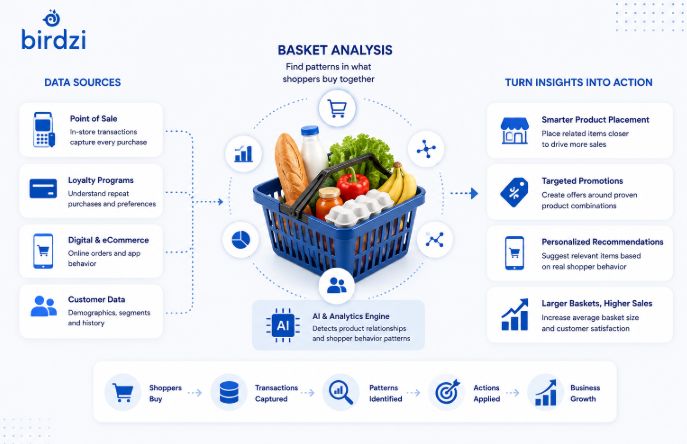
Product placement is the most direct application. When bread, eggs, and butter consistently appear together, moving them physically closer in store removes friction for the shopper and increases the odds of a third or fourth item making it into the basket.
Promotions work the same way. Instead of guessing which items to bundle, a retailer can build a discount around products that are already proven to sell together, which tends to perform better than a bundle chosen at random.
Personalized recommendations, whether through a mobile app or a loyalty program, can also lean on this data. If a shopper adds pasta to their online cart, a suggestion for sauce or parmesan is not a guess. It is based on what thousands of other shoppers have already done.
What Basket Analysis Reveals About Shopper Behavior Analytics
Basket combinations often say more about the shopper than the products themselves. A basket full of protein shakes, frozen chicken, and sports drinks suggests a very different household than one filled with baby formula, diapers, and baby food.
This is where basket analysis connects to something larger. It becomes an early signal within shopper behavior analytics, giving retailers a way to understand lifestyle and household needs without ever asking a customer a single question. The basket already answers it, and Birdzi’s Shopper Engagement Tools help turn that understanding into outreach that actually reflects it.
A Practical Example of Basket Analysis in Action
Picture a mid sized grocery chain reviewing several months of checkout data. The analysis shows a strong, repeated connection between bread, eggs, and butter, three items that rarely appear in a basket without at least two of the others present.
The retailer responds in two ways. First, the products are placed closer together on the shelf. Second, a small breakfast bundle promotion is built around the trio. Within a few months, the average basket size for shoppers who buy any of these three items increases, not because shoppers were told to buy more, but because the store simply made it easier to buy what they were already inclined to purchase.
This is the quiet power of basket analysis. It does not invent new behavior. It removes the friction standing in front of behavior that already exists.
Where Retail Shopper Analytics and Birdzi Fit In
Basket level insight depends entirely on how connected the underlying data is. A retailer working from point of sale records alone sees only part of the picture. A retailer working from point of sale, loyalty, and digital data together sees the full basket, every time.
Birdzi brings these sources into one platform, so grocery retailers are not left piecing together fragments from separate systems. With Birdzi’s Shopper Analytics platform built into that connected view, retailers can move past isolated transaction reports and start making decisions based on how products actually relate to one another across the entire customer base.
What Comes Next for Basket and Grocery Store Analytics
As grocery retail becomes more digital, basket analysis is likely to move from a periodic report to a real time capability, surfacing product relationships as a shopper is still building their cart rather than weeks after the transaction has already closed. Retailers who adopt this earlier will have more room to act on it, whether through in store layout or personalized digital offers.
Conclusion
Basket analysis turns an ordinary transaction into a source of insight. By studying which products are purchased together, grocery retailers can make sharper decisions about placement, promotions, and personalization, all grounded in real shopping behavior rather than assumption.
With a connected data platform like Birdzi, that insight becomes far easier to act on, helping retailers turn everyday checkout data into decisions that grow basket size and strengthen the overall shopping experience.
Frequently Asked Questions
Q1. What is basket analysis in grocery retail?
A: Basket analysis studies which products customers purchase together in a single transaction, revealing relationships between products rather than treating each purchase as isolated.
Q2. Why does basket analysis matter for grocery retailers?
A: It helps retailers make informed decisions about product placement, promotions, and recommendations based on actual purchase patterns rather than guesswork.
Q3. What data does basket analysis rely on?
A: It relies primarily on point of sale transaction history, which records which products are bought together across many shopping trips.
Q4. How does basket analysis improve the shopping experience?
A: By surfacing products that are frequently bought together, retailers can place items conveniently and offer promotions that match real shopping habits rather than generic bundles.
Q5. How does Birdzi support basket analysis?
A: Birdzi connects point of sale, loyalty, and digital data into one platform, giving grocery retailers a complete view of basket patterns rather than fragments pulled from separate systems.
Sign up for Updates
Stay current on the latest happenings at Birdzi!
"*" indicates required fields
Related Posts
 " alt="How Grocers Can Deliver More Relevant Product Suggestions" />
 " alt="Using Shopping Frequency to Understand Customer Value" />
 " alt="How Retailers Can Create More Meaningful Shopper Touchpoints" />
Request a 1-on-1 Demo
There’s no substitute for seeing Birdzi’s capabilities first-hand with a seasoned expert to answer all your questions.
"*" indicates required fields