For decades, grocery retailers have relied on past sales reports, but by the time a report is generated, the behavior it describes has already happened. Retailers have been reacting to yesterday’s data instead of preparing for tomorrow’s demand.
That is changing. With the rise of predictive analytics, retailers can now anticipate what a customer is likely to buy next, when they are likely to visit, and what offer will actually get their attention before the moment is gone.
For grocery marketing and merchandising leaders, this is not just a technology upgrade, but a fundamentally different way of running the business, moving from reactive reporting to proactive, data driven decision making.
What Is Predictive Analytics in Grocery Retail?
Predictive analytics uses historical and real time shopper data, including purchase history, loyalty activity, browsing behavior, and seasonal trends, to forecast what is likely to happen next. Rather than simply showing what customers bought last month, it estimates what they are likely to buy next week, next holiday, or even during their next visit.
In grocery specifically, this means retailers can move beyond broad demographics and start working with individual level predictions, such as which shoppers are likely to try a new product category, which are at risk of switching to a competitor, and which promotions are likely to convert versus be ignored. This is the kind of precision that Birdzi’s Shopper Personalization Platform is built to deliver, turning individual level predictions into offers shoppers actually respond to.
This is where predictive analytics for customer behavior modeling becomes essential. It turns scattered data points into a forward looking view of each shopper, rather than a static snapshot of what already happened.
Why Grocery Retailers Are Turning to Predictive Analytics
Grocery is a high frequency, low margin business, where small improvements in targeting and timing compound quickly across millions of transactions. Shopper expectations have shifted toward relevant offers, margins remain tight, competition has intensified, and data volume has exploded beyond what teams can manually analyze.
Retailers that apply grocery retail analytics to this data are better positioned to convert that complexity into a competitive advantage, rather than being buried by it.
How Predictive Analytics Actually Works
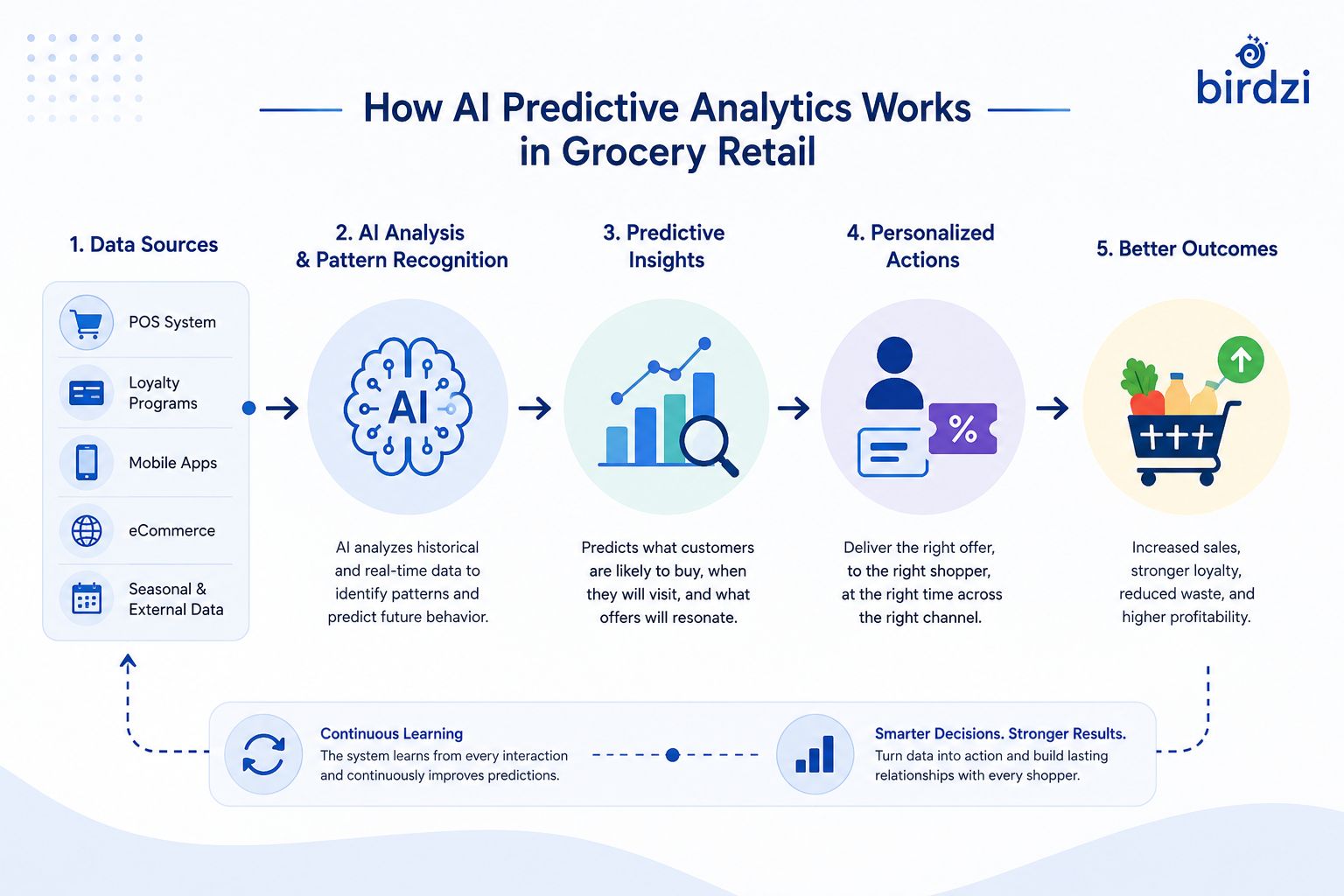
At a high level, predictive analytics in grocery retail follows a simple flow.
The process behind ai grocery predictive analytics begins with data collection, pulling information from point of sale systems, loyalty programs, eCommerce, and mobile apps into one connected system. Pattern recognition then allows AI models to identify trends across purchase frequency, basket composition, and timing.
Forecasting predicts future behavior, such as the likelihood to purchase a specific category or the risk of churn. Finally, action lets marketing and merchandising teams turn these predictions into personalized campaigns, promotions, or in-store decisions using Birdzi’s Shopper Engagement Tools, which help translate insight into timely, relevant outreach.
Real World Applications of Predictive Analytics in Grocery Retail
Predictive analytics is not a theoretical concept. It is already shaping decisions across grocery retail in several practical ways.
One of the clearest applications is personalized promotions. Instead of sending the same weekly ad to every shopper, retailers can predict which products a specific customer is likely to buy next and deliver a relevant offer at the right time. Predictive analytics also supports inventory and demand planning, since forecasting demand at the category or even product level helps retailers reduce waste, especially for perishable goods like produce, dairy, and bakery items.
Churn prevention, seasonal and event based planning, and loyalty program optimization are three more key use cases. Predictive models can flag shoppers showing early signs of disengagement so retailers can reach out before they are lost, anticipate shifts in shopping behavior around holidays and local events to plan promotions and staffing in advance, and identify which loyalty offers are likely to drive repeat visits for specific segments rather than applying a one size fits all approach.
Each of these use cases shares a common thread: they turn raw shopper data into a forward looking decision, rather than a backward looking report.
How Birdzi Applies Predictive Analytics for Grocery Retailers
Birdzi was built specifically for grocery retail, which means predictive analytics is not treated as an isolated add on. It is embedded directly into how retailers understand, manage, activate, and orchestrate every customer relationship.
Through its Understand capability, Birdzi unifies data from point of sale, loyalty, eCommerce, and digital channels into a single, connected view of each shopper. This connected foundation is what makes accurate prediction possible in the first place, since fragmented data leads to fragmented insight.
Birdzi’s platform applies advanced analytics to anticipate shopper needs, allowing retailers to move from broad segments to individual level personalization and deliver the right offer to the right shopper at the right moment.
A Simple Example
Consider a shopper who has gradually reduced her visit frequency over the past two months and has stopped redeeming her usual loyalty offers. A traditional sales report would only show a decline in revenue from that customer, often too late to act on it.
Predictive analytics identifies this pattern early and flags her as a shopper at risk of disengaging. The retailer can then respond with a personalized offer built around her previous favorite categories, along with a loyalty incentive to bring her back before she fully disengages.
This is the practical difference predictive analytics makes. It turns a quiet warning sign into a timely, personalized action.
The Future of Predictive Analytics in Grocery Retail
As competition intensifies and shopper expectations rise, predictive analytics will likely shift from a competitive advantage to a baseline expectation, leaving retailers who rely solely on historical reporting a step behind. The next stage of this shift will likely focus on speed and automation, where predictions translate into action in near real time rather than requiring manual review before launch.
Conclusion
Grocery retail has always been built on repeat relationships, not single transactions. Predictive analytics allows retailers to strengthen those relationships by anticipating what shoppers need before they ask for it, rather than reacting after a sale has already happened or a customer has already left.
By connecting data across every channel and applying Birdzi’s Shopper Analytics platform to that information, retailers can move from reactive reporting to proactive, personalized engagement, ultimately driving stronger loyalty, higher basket sizes, and long term revenue growth.
Frequently Asked Questions
Q1. What is predictive analytics in grocery retail?
A: Predictive analytics uses historical and real time shopper data to forecast future behavior, such as what a customer is likely to buy next or when they are likely to visit again.
Q2. Why is predictive analytics important for grocery retailers?
A: It allows retailers to move from reactive decision making to proactive engagement, helping improve customer retention, reduce waste, and increase marketing effectiveness.
Q3. How does predictive analytics improve customer retention?
A: By identifying early signs of disengagement, such as reduced visit frequency, retailers can reach out to at risk shoppers with personalized offers before they stop shopping altogether.
Q4. What data is used for predictive analytics in grocery retail?
A: Predictive models typically use point of sale data, loyalty program activity, eCommerce behavior, mobile app usage, and seasonal purchasing trends.
Q5. How does Birdzi support predictive analytics for grocery retailers?
A: Birdzi unifies shopper data across every channel and applies advanced analytics to anticipate customer behavior, enabling personalized, timely engagement at scale.
Sign up for Updates
Stay current on the latest happenings at Birdzi!
"*" indicates required fields
Related Posts
 " alt="How Grocers Can Make Promotions More Relevant to Shoppers" />
 " alt="How Grocery Retailers Can Adapt Marketing to Changing Shopper Behavior" />
 " alt="What Should Grocers Look for in Customer Engagement Technology?" />
Request a 1-on-1 Demo
There’s no substitute for seeing Birdzi’s capabilities first-hand with a seasoned expert to answer all your questions.
"*" indicates required fields