Grocery retailers collect valuable information with every transaction, from what shoppers buy to how often they visit and which categories they prefer. The challenge is turning this purchase data into meaningful insights that can guide better marketing and customer engagement decisions.
Not every shopper contributes the same value to a grocery business. Some purchase frequently, maintain larger baskets, and remain loyal over time, while others shop occasionally or respond only to promotions. By analyzing these behaviors, retailers can identify high-value shoppers and create more relevant strategies to retain and grow those relationships.
What Makes a Grocery Shopper High Value?
A high-value shopper is not necessarily the person who spends the most during a single visit. Customer value is better understood by looking at purchasing behavior over time.
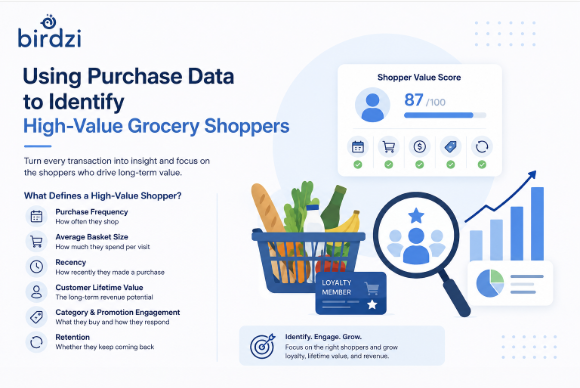
Several factors can help retailers identify valuable shoppers, including:
- Purchase frequency: How often the customer visits and makes purchases
- Average basket size: The typical amount spent per transaction
- Recency: How recently the customer made a purchase
- Customer lifetime value: The potential revenue generated throughout the relationship
- Category engagement: The variety and frequency of products or categories purchased
- Promotion response: How customers react to discounts, offers, and incentives
- Retention: Whether customers continue shopping with the retailer over time
When these signals are analyzed together, retailers can create a more complete picture of shopper value instead of relying on a single metric.
For retailers looking to move beyond basic transaction reporting, Birdzi’s Shopper Analytics platform can help turn loyalty, transaction, and digital interaction data into actionable customer intelligence.
Why Purchase Data Is More Useful Than Broad Segmentation
Traditional customer segmentation can provide useful information about shoppers, but broad demographic categories do not always explain purchasing behavior.
Two customers may live in the same area and have similar demographic characteristics while behaving very differently in the store. One might shop every week and purchase premium products, while the other visits only when specific items are discounted.
Purchase data provides a behavioral view of the customer.
It can show what shoppers actually do rather than what retailers assume they might do. This makes transaction history particularly useful for identifying valuable customers and understanding the behaviors that contribute to long-term revenue.
5 Ways to Identify High-Value Grocery Shoppers
1. Measure Purchase Frequency
Frequent shoppers can represent significant long-term value because they consistently return to the store.
Retailers can analyze transaction histories to identify customers who shop weekly, biweekly, or monthly. Frequency becomes even more meaningful when combined with average basket value.
For example, a customer who visits four times a month and consistently makes substantial purchases may have greater long-term value than someone who makes one large purchase every few months.
2. Analyze Spending Over Time
Total customer spending is useful, but retailers should examine how that spending develops over time.
A shopper’s average transaction value, purchase frequency, and spending consistency can reveal whether the customer represents stable revenue or occasional activity.
Looking at these metrics together also helps retailers distinguish between temporary spikes in spending and genuine long-term customer value.
3. Understand Category Preferences
The products customers purchase can reveal important opportunities.
A shopper may consistently purchase fresh foods, household essentials, prepared meals, or premium products. Understanding these preferences allows retailers to build more relevant customer segments.
Category analysis can also identify potential cross-selling opportunities. If customers who purchase one category frequently purchase products from another, retailers can use that insight when developing personalized recommendations or promotions.
4. Evaluate Promotion Response
High-value customers do not all respond to promotions in the same way.
Some shoppers may actively seek discounts, while others may respond better to personalized recommendations, loyalty rewards, or exclusive offers.
By examining how customers behave after receiving specific promotions, retailers can determine which incentives are actually influencing purchases. This can make promotional budgets more efficient while creating a better experience for shoppers.
5. Monitor Changes in Customer Behavior
Customer value can change over time.
A previously loyal customer may begin visiting less frequently, reducing their future value to the retailer. At the same time, an occasional shopper may gradually increase purchase frequency and become a more valuable customer.
Monitoring these changes can help retailers identify both opportunities and risks before they become significant revenue problems.
Turning Customer Data Into Personalized Experiences
Identifying a valuable customer is only the first step. Retailers need a strategy for turning those insights into relevant experiences.
Instead of treating every shopper the same, retailers can create behavioral segments based on actual purchase activity.
For example, a grocery retailer might create segments for:
- Frequent high-spend shoppers
- Customers showing signs of declining engagement
- Shoppers with strong preferences for specific categories
- Customers who regularly respond to promotions
- Shoppers with cross-category purchase opportunities
- Recently acquired customers showing strong growth potential
Each group can then receive messaging and offers that reflect its behavior.
This approach can also help retailers avoid unnecessary promotions. A customer who already purchases a product regularly may not need the same incentive as someone who has stopped purchasing it.
Measuring Whether Personalization Drives Revenue
Personalization should not end when an offer is sent. Retailers also need to understand what happens afterward.
Did the customer increase their basket size? Did purchase frequency improve? Did a previously inactive shopper return? Did the promotion generate enough incremental revenue to justify its cost?
These questions connect customer engagement with measurable business outcomes.
A data-driven strategy should create a continuous process:
Collect data → identify patterns → build segments → personalize experiences → measure results → improve the strategy.
This makes customer analytics more than a reporting exercise. It becomes a way to guide marketing, loyalty, merchandising, and customer engagement decisions.
Building Stronger Customer Relationships
High-value shoppers should not always be treated as customers who simply need more discounts.
In many cases, the better strategy is to understand what each shopper actually values.
One customer may appreciate savings on frequently purchased products. Another may prefer personalized product recommendations. A highly loyal shopper may respond more positively to exclusive rewards or recognition.
The more retailers understand individual behavior, the easier it becomes to create experiences that feel useful rather than generic.
Personalization can therefore support both short-term engagement and long-term customer retention.
Create a Smarter Strategy for Your Most Valuable Shoppers
Every grocery retailer has customers who contribute significant long-term value. The challenge is identifying them accurately and understanding what keeps them coming back.
Purchase data provides the foundation. By analyzing frequency, spending, recency, category preferences, promotion response, and behavioral changes, retailers can build more useful customer segments and make their marketing efforts more targeted.
But insights are only valuable when they lead to action.
Retailers that connect customer intelligence with personalized experiences can improve engagement while gaining a clearer understanding of which strategies contribute to revenue. Birdzi’s Shopper Personalization Platform helps retailers connect shopper behavior with personalized strategies and measurable business outcomes.
Frequently Asked Questions
Q.1 What is a high-value grocery shopper?
A: A high-value grocery shopper is a customer who provides significant current or potential long-term value to a retailer. Purchase frequency, basket size, recency, retention, category engagement, and lifetime value can all help determine customer value.
Q.2 How does purchase data help identify valuable shoppers?
A: Purchase data shows how customers actually behave. Retailers can analyze transaction frequency, spending, product preferences, promotion response, and changes in purchasing habits to identify shoppers with strong current or future value.
Q3. Is customer spending enough to determine shopper value?
A: No. Spending is an important metric, but it should be considered alongside purchase frequency, recency, retention, and other behavioral signals. A customer with consistent purchasing habits may have greater long-term value than someone who makes occasional large purchases.
Q.4 How can retailers use high-value shopper segments?
A: Retailers can use these segments to personalize promotions, improve loyalty programs, identify cross-selling opportunities, develop targeted campaigns, and recognize customers who may be at risk of becoming inactive.
Q.5 How can grocery retailers turn shopper insights into action?
A: Retailers can connect analytics with marketing and engagement tools to create personalized experiences based on customer behavior. Birdzi’s Shopper Engagement Tools are designed to help retailers move from customer insights to relevant engagement and action.
Sign up for Updates
Stay current on the latest happenings at Birdzi!
"*" indicates required fields
Related Posts
 " alt="How Grocers Can Deliver More Relevant Product Suggestions" />
 " alt="Using Shopping Frequency to Understand Customer Value" />
 " alt="How Retailers Can Create More Meaningful Shopper Touchpoints" />
Request a 1-on-1 Demo
There’s no substitute for seeing Birdzi’s capabilities first-hand with a seasoned expert to answer all your questions.
"*" indicates required fields