Pricing is one of the most powerful levers a grocery retailer has. Get it right and you attract more shoppers, grow basket sizes, and build a reputation that keeps customers coming back. Get it wrong and you either leave money on the table or push price sensitive shoppers straight to a competitor. In the world of eCommerce grocery, where shoppers can compare prices instantly and loyalty is hard earned, having a smart pricing strategy is not optional. It is essential.
This guide covers the most effective pricing strategies for eCommerce grocery businesses, how to think about them, and how using the right shopper intelligence tools can help you price with confidence rather than guesswork.
Why Pricing Is More Complex in eCommerce Grocery
Pricing in a physical grocery store has always been competitive. But in the eCommerce space, the pressure intensifies. Shoppers browsing your online store can open three competitor tabs in seconds. Price comparison is effortless. And the perception of value is shaped not just by the numbers but by the entire shopping experience, from personalised offers to how easy it is to find and buy what they need.
At the same time, grocery margins are notoriously thin. Deep discounting across the board is not a sustainable strategy. The goal is to find a pricing approach that attracts and retains the right shoppers without sacrificing profitability. That balance is where strategy, data, and technology come together.
For mid size to enterprise grocery retailers, the answer increasingly lies in using shopper analytics to understand how different customer segments respond to pricing changes, promotions, and personalised offers. Without that data, pricing decisions are made in the dark.
Core Pricing Strategies Every Grocery eCommerce Business Should Know
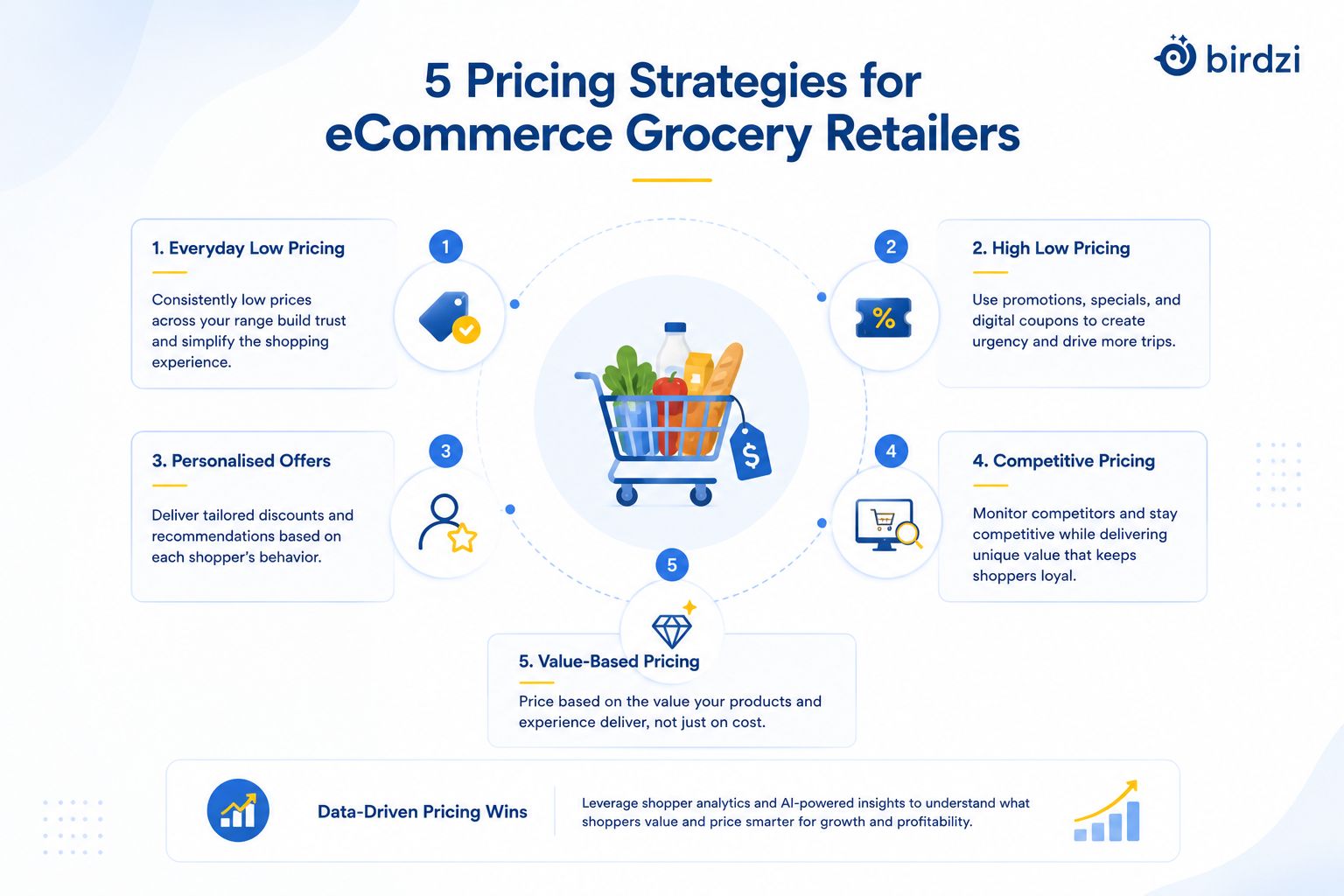
1. Everyday Low Pricing
Everyday low pricing means committing to consistently low prices across your range rather than running frequent promotional discounts. The appeal for shoppers is simplicity. They know they are always getting a fair price without having to wait for a sale. For retailers, it reduces the operational complexity of managing constant promotions and builds a reputation for value.
Everyday low pricing works best when your cost structure supports it and when your target shopper values consistency over excitement. However, it can make it harder to create urgency or drive incremental trips without promotional hooks.
2. High Low Pricing
High low pricing is the opposite approach. Regular prices sit higher but frequent promotional deals, weekly specials, and digital coupons create perceived savings that drive purchase decisions. This is the model most familiar to traditional grocery shoppers and it remains highly effective when executed well.
The key to making high low pricing work in eCommerce is relevance. A blanket discount on a category that a shopper never buys does nothing. But a targeted digital coupon on a product they purchase regularly drives a trip. Birdzi’s Shopper Engagement Tools are built precisely for this, giving grocery retailers the ability to deploy digital coupons and promotional offers that are tied to real shopper behaviour rather than broadcast to everyone on the list.
3. Personalised Pricing and Offers
Personalised pricing does not mean charging different shoppers different prices for the same item. It means tailoring the promotions, discounts, and loyalty rewards each shopper sees based on their individual purchase history and preferences. This is one of the most powerful pricing strategies available to grocery retailers today, and it is only possible with the right technology.
When a shopper receives an offer that feels made for them specifically, the response rate is dramatically higher than a generic promotion. Birdzi’s Shopper Personalization Platform automates this process, analysing each shopper’s behaviour and generating the most relevant promotions and recommendations for them individually. The result is better engagement, larger baskets, and stronger loyalty, all without requiring your marketing team to manually build out hundreds of offer variations.
4. Competitive Pricing
Competitive pricing means keeping a close eye on what your rivals are charging and positioning your prices relative to them. In eCommerce grocery, this is a baseline requirement. Shoppers notice when your prices are significantly out of step with the market, and the barrier to switching is low.
That said, competing purely on price is a race to the bottom. The retailers who win long term do not just match competitor prices. They use competitive pricing as a floor while building additional value through personalisation, loyalty rewards, convenience, and a superior digital experience. Price is important, but it is rarely the only reason a shopper stays loyal.
5. Value Based Pricing
Value based pricing anchors your prices to the perceived value your products and services deliver to the shopper, rather than solely to your costs or competitor benchmarks. In grocery eCommerce, this plays out in areas like premium or specialty products, exclusive loyalty rewards, and convenience features like same day delivery or subscription bundles.
Shoppers who feel they are getting genuine value, whether through superior product selection, a seamless experience, or rewards that actually matter to them, are far less price sensitive than those whose only reason to shop with you is a lower sticker price.
The Role of Shopper Data in Smarter Pricing Decisions
Every pricing strategy discussed above becomes significantly more effective when it is backed by real shopper data. This is where Birdzi plays a central role for grocery retailers. Birdzi’s Customer Intelligence Platform brings together data from loyalty programs, point of sale systems, and eCommerce channels to give retailers a unified view of how their shoppers actually behave.
- With this data, grocery teams can answer critical pricing questions with confidence:
- Which customer segments are most price sensitive and which respond better to convenience or loyalty rewards?
- Which promotions are genuinely driving incremental sales versus simply discounting purchases shoppers would have made anyway?
- Which products are shoppers most likely to switch to a competitor for if your price moves up?
- Which high value shoppers are at risk of churning and what offer would be most likely to retain them?
Birdzi’s proprietary Shopper Quality Index, or KIC scores, gives retailers a 360 degree view of each individual shopper, including their sensitivity to price and promotions. Combined with the platform’s shopper analytics capabilities, this means pricing decisions are grounded in evidence rather than assumptions.
Loyalty Programs as a Pricing Strategy in Their Own Right
One of the most underutilised pricing levers in grocery eCommerce is the loyalty program itself. A well structured loyalty program effectively changes the price equation for your most engaged shoppers. They earn rewards on every purchase, which increases the perceived value of buying from you rather than a competitor even if your shelf prices are similar.
The challenge many retailers face is that their loyalty programs feel generic and transactional. Shoppers accumulate points but rarely feel that the program is designed with them in mind. Birdzi solves this with its Shopper Engagement Tools and personalisation capabilities working together. When loyalty rewards are tied to the specific products and categories a shopper actually buys, the program feels meaningful rather than an afterthought.
This approach also has a direct impact on pricing power. A shopper who is deeply engaged with your loyalty program is far less likely to be swayed by a competitor offering a slightly lower price on a given week. The value of the relationship they have built with your brand, and the rewards they stand to lose by switching, acts as a natural price buffer.
Avoiding Common Pricing Mistakes in eCommerce Grocery
Even well intentioned pricing strategies can go wrong. Here are some of the most common pitfalls grocery eCommerce businesses fall into:
- Discounting without data: Running promotions based on gut feel or historical habit rather than actual shopper response data leads to margin erosion without meaningful loyalty gains.
- One size fits all offers: Broadcasting the same promotion to your entire database ignores the fact that different shoppers have very different needs, preferences, and price sensitivities.
- Ignoring the post purchase experience: Price gets a shopper to convert, but the experience after the purchase determines whether they come back. Pricing strategy must be paired with engagement strategy.
- Short term thinking: Aggressive discounting to hit a monthly sales target can train shoppers to only buy on promotion, making it harder to sell at full price over time.
- Failing to measure ROI: If you cannot see which promotions are actually driving profitable behaviour, you cannot improve. Clear measurement frameworks are essential.
Bringing It All Together With the Right Platform
The most effective pricing strategy for your eCommerce grocery business is not a single approach. It is a combination of the strategies above, informed by deep shopper intelligence and executed through tools that allow you to personalise at scale without overwhelming your team.
This is exactly what Birdzi is built to deliver. As a Customer Intelligence Platform designed specifically for grocery, Birdzi unifies your loyalty data, POS data, and digital engagement data into a single platform. From there, advanced analytics and machine learning power personalised promotions, targeted engagement, and loyalty rewards that feel genuinely relevant to each shopper.
Whether you are refining your promotional cadence, building a more intelligent loyalty program, or trying to understand which customer segments are most at risk from a pricing shift, Birdzi gives you the visibility and the tools to act with confidence.
Make Pricing a Competitive Advantage
Pricing in eCommerce grocery does not have to be a guessing game. When you combine a clear pricing strategy with real shopper intelligence, you move from reactive discounting to proactive engagement. You stop giving away margin to shoppers who would have bought anyway and start using pricing as a genuine tool for building loyalty and driving growth.
Birdzi helps grocery retailers do exactly that. From shopper analytics that reveal how your customers respond to pricing and promotions, to a personalisation platform that delivers the right offer to the right shopper at the right time, Birdzi is the platform that turns pricing strategy into competitive advantage. Ready to see how it works for your business? Explore Birdzi today and take the first step toward smarter, data driven grocery pricing.
Sign up for Updates
Stay current on the latest happenings at Birdzi!
"*" indicates required fields
Related Posts
 " alt="Loyalty Isn't Dead. We've Just Been Measuring the Wrong Things." />
 " alt="Boost Revenue with These Online Grocery Marketing Strategies" />
 " alt="6 Future Trends Every Grocer Should Know About" />
Request a 1-on-1 Demo
There’s no substitute for seeing Birdzi’s capabilities first-hand with a seasoned expert to answer all your questions.
"*" indicates required fields