Grocery retail is one of the most competitive industries in the world. Shoppers have more choices than ever before, from big box stores to online delivery services. Keeping your existing customers coming back is not just important; it is essential for long-term growth.
Shopper retention is the foundation of a profitable grocery business. Acquiring a new customer costs significantly more than keeping an existing one. Yet many grocery retailers still focus most of their energy on attracting new shoppers rather than retaining the ones they already have.
This guide breaks down what shopper retention really means, how to measure it accurately, and what practical steps grocery retailers can take to improve it.
What Is Shopper Retention in Grocery Retail?
Shopper retention refers to your ability to keep customers coming back to your store over time. A retained shopper continues to choose your store for their grocery needs rather than switching to a competitor.
In grocery retail, retention is not just about loyalty points or weekly deals. It is about building a relationship with your shoppers that makes them feel understood, valued, and consistently satisfied.
Why Shopper Retention Matters More Than You Think
Most grocery retailers track sales, foot traffic, and weekly ad performance. But very few have a clear picture of how many shoppers they are actually losing every month.
Here is why retention should be a top priority:
Retained shoppers spend more. A loyal shopper visits more frequently and spends more per trip than a new or occasional customer.
Retention drives predictable revenue. When you know your retention rate, you can forecast revenue more reliably and plan your marketing budget with confidence.
Word of mouth grows from loyal shoppers. Satisfied, loyal customers are more likely to recommend your store to friends and family.
It is more cost-efficient. Retaining an existing shopper is far less expensive than running campaigns to attract new ones.
How to Measure Shopper Retention in Grocery Retail
Before you can improve retention, you need to measure it properly. Here are the key metrics every grocery retailer should track.
1. Customer Retention Rate
This is the percentage of shoppers who continue to purchase from your store over a specific time period.
Formula: Retention Rate = ((Customers at End of Period – New Customers Acquired) / Customers at Start of Period) x 100
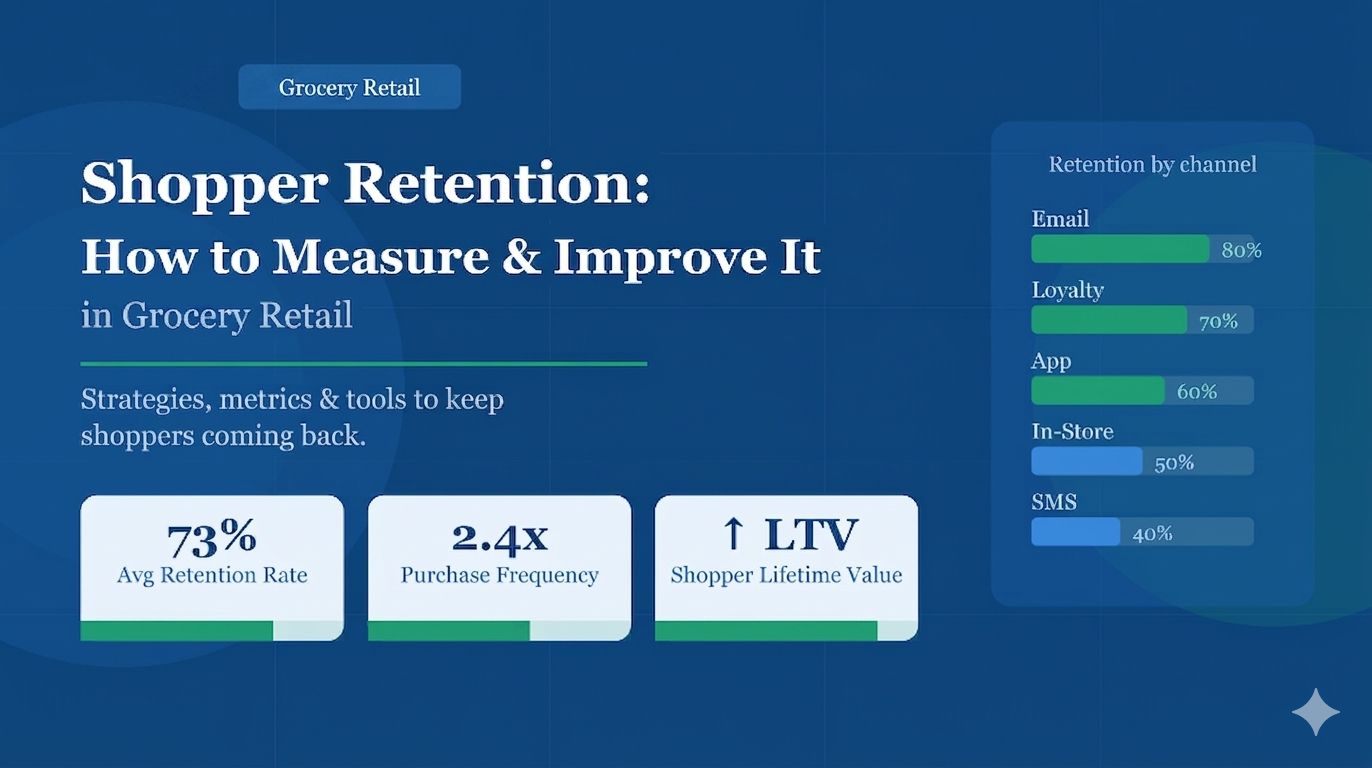
A healthy retention rate in grocery retail typically falls between 60% and 80%, though this varies by market and store type.
2. Churn Rate
Churn rate is the opposite of retention. It tells you how many shoppers stopped buying from you during a given period.
Formula: Churn Rate = (Customers Lost During Period / Customers at Start of Period) x 100
Even a small reduction in churn rate can have a major impact on your bottom line.
3. Purchase Frequency
How often does a shopper visit your store within a set time frame? Declining visit frequency is often an early warning sign that a shopper is drifting away.
4. Average Basket Size
Are your retained shoppers spending more or less over time? A shrinking basket size can indicate disengagement, even if the shopper is still visiting.
5. Shopper Lifetime Value (LTV)
LTV measures the total revenue a shopper generates over the course of their relationship with your store. Retailers with strong retention strategies consistently see higher LTV across their customer base.
Consistently tracking these metrics is only possible when you have unified shopper data. That is where platforms like Birdzi make a real difference, bringing together loyalty, POS, and eCommerce data into one clear view of every shopper.
Common Reasons Grocery Shoppers Leave
Understanding why shoppers leave is just as important as tracking the numbers. The most common reasons include:
- Feeling like just another anonymous customer with no personalized experience
- Receiving irrelevant promotions that do not match their buying habits
- Poor digital experience across app, email, or website
- Lack of reward for consistent loyalty
- Better deals or convenience offered by a competitor
Most of these problems come down to one root cause: the retailer does not know their shopper well enough to keep them engaged.
How to Improve Shopper Retention in Grocery Retail
Here are proven strategies that help grocery retailers improve retention in a meaningful and measurable way.
1. Unify Your Shopper Data
Retention starts with understanding. If your loyalty data, POS data, and eCommerce data are sitting in separate systems, you are missing the full picture of your shopper. Unified data gives you the ability to see exactly who is at risk of churning and why.
Birdzi’s shopper analytics platform gives grocery retailers a 360-degree view of every shopper, including their purchase history, engagement patterns, and overall shopper quality through a proprietary scoring system called the KIC Score.
2. Identify At-Risk Shoppers Early
Do not wait until a shopper has already left to take action. Use predictive analytics to spot behavioral signals that indicate disengagement, such as declining visit frequency or a drop in basket size.
When you identify at-risk shoppers early, you can reach them with the right message before they switch to a competitor.
3. Personalize Every Touchpoint
Generic promotions do not retain shoppers. Personalized experiences do. When a shopper receives an offer that feels relevant to their actual buying habits, they are far more likely to act on it and come back.
Birdzi’s personalization platform automatically analyzes shopper behavior and delivers customized promotions, recommendations, and content that drive larger baskets, more frequent visits, and stronger long-term loyalty.
4. Strengthen Your Engagement Across Channels
Retention is not just an in-store experience. It happens across email, SMS, your app, and your website. Consistent, relevant communication across all these channels keeps your store top of mind between shopping trips.
With Birdzi’s shopper engagement tools, grocery retailers can manage digital coupons, loyalty programs, email campaigns, and points programs all from one platform, making it easier to stay connected with shoppers at every stage.
5. Reward Loyalty in a Meaningful Way
Points programs are a good start, but they are not enough on their own. Shoppers want to feel genuinely appreciated. Offering personalized rewards based on actual purchase behavior is far more effective than a one-size-fits-all points system.
6. Measure, Learn, and Adjust
Retention improvement is not a one-time project. It requires ongoing measurement and refinement. Set a baseline, track your retention metrics monthly, and use the data to continuously improve your targeting, messaging, and offers.
Final Thoughts
Shopper retention is one of the highest return investments a grocery retailer can make. The retailers who win long-term are the ones who know their shoppers deeply, engage them consistently, and deliver experiences that feel personal and relevant.
If your team is ready to move beyond generic loyalty programs and start building real, measurable retention, Birdzi gives you the data, tools, and personalization capabilities to make it happen.
Sign up for Updates
Stay current on the latest happenings at Birdzi!
"*" indicates required fields
Related Posts
 " alt="How Grocers Can Make Promotions More Relevant to Shoppers" />
 " alt="How Grocery Retailers Can Adapt Marketing to Changing Shopper Behavior" />
 " alt="What Should Grocers Look for in Customer Engagement Technology?" />
Request a 1-on-1 Demo
There’s no substitute for seeing Birdzi’s capabilities first-hand with a seasoned expert to answer all your questions.
"*" indicates required fields